Links
- All Blacks
- Gunther's Block
- HTML Assistance
- New Zealand Electronic Poetry Center
- Dong Resin
- A=R=C=H=I=V=E=S
- Ilia Dreams Blog
- Swingin' Chicks of the 60's (broken link)
- Online Rhyming Dictionary
- Maoritanga
- Dagmar Chili
- NZ eZines
- Rules of Lojban PDF //Talk to Ken Springtail
Archives
- 03/01/2004 - 04/01/2004
- 04/01/2004 - 05/01/2004
- 05/01/2004 - 06/01/2004
- 06/01/2004 - 07/01/2004
- 07/01/2004 - 08/01/2004
- 08/01/2004 - 09/01/2004
- 09/01/2004 - 10/01/2004
- 10/01/2004 - 11/01/2004
- 11/01/2004 - 12/01/2004
- 12/01/2004 - 01/01/2005
- 01/01/2005 - 02/01/2005
- 02/01/2005 - 03/01/2005
- 03/01/2005 - 04/01/2005
- 04/01/2005 - 05/01/2005
- 05/01/2005 - 06/01/2005
- 06/01/2005 - 07/01/2005
- 07/01/2005 - 08/01/2005
- 08/01/2005 - 09/01/2005
- 09/01/2005 - 10/01/2005
- 10/01/2005 - 11/01/2005
- 11/01/2005 - 12/01/2005
- 12/01/2005 - 01/01/2006
- 01/01/2006 - 02/01/2006
- 02/01/2006 - 03/01/2006
- 03/01/2006 - 04/01/2006
- 04/01/2006 - 05/01/2006
- 05/01/2006 - 06/01/2006
- 06/01/2006 - 07/01/2006
- 07/01/2006 - 08/01/2006
- 08/01/2006 - 09/01/2006
- 09/01/2006 - 10/01/2006
- 10/01/2006 - 11/01/2006
- 11/01/2006 - 12/01/2006
- 12/01/2006 - 01/01/2007
- 01/01/2007 - 02/01/2007
- 02/01/2007 - 03/01/2007
- 03/01/2007 - 04/01/2007
- 04/01/2007 - 05/01/2007
- 05/01/2007 - 06/01/2007
- 06/01/2007 - 07/01/2007
- 07/01/2007 - 08/01/2007
- 08/01/2007 - 09/01/2007
- 09/01/2007 - 10/01/2007
- 10/01/2007 - 11/01/2007
- 11/01/2007 - 12/01/2007
- 12/01/2007 - 01/01/2008
- 01/01/2008 - 02/01/2008
- 03/01/2008 - 04/01/2008
- 04/01/2008 - 05/01/2008
- 05/01/2008 - 06/01/2008
- 06/01/2008 - 07/01/2008
- 07/01/2008 - 08/01/2008
- 08/01/2008 - 09/01/2008
- 04/01/2009 - 05/01/2009
- 06/01/2009 - 07/01/2009
- 07/01/2009 - 08/01/2009
- 08/01/2009 - 09/01/2009
- 09/01/2009 - 10/01/2009
- 02/01/2010 - 03/01/2010
- 06/01/2010 - 07/01/2010
- 07/01/2010 - 08/01/2010
- 10/01/2010 - 11/01/2010
- 03/01/2011 - 04/01/2011
- 08/01/2011 - 09/01/2011
- 12/01/2011 - 01/01/2012
- 02/01/2012 - 03/01/2012
- 06/01/2012 - 07/01/2012
- 09/01/2012 - 10/01/2012
- 10/01/2012 - 11/01/2012
- 02/01/2013 - 03/01/2013
- 04/01/2013 - 05/01/2013
- 07/01/2013 - 08/01/2013
- 10/01/2013 - 11/01/2013
- 02/01/2014 - 03/01/2014
- 05/01/2014 - 06/01/2014
- 06/01/2014 - 07/01/2014
- 08/01/2014 - 09/01/2014
- 09/01/2014 - 10/01/2014
- 12/01/2014 - 01/01/2015
- 06/01/2015 - 07/01/2015
- 09/01/2015 - 10/01/2015
- 11/01/2015 - 12/01/2015
- 01/01/2016 - 02/01/2016
- 03/01/2016 - 04/01/2016
- 06/01/2016 - 07/01/2016
- 08/01/2016 - 09/01/2016
- 09/01/2016 - 10/01/2016
- 10/01/2016 - 11/01/2016
- 12/01/2016 - 01/01/2017
- 02/01/2017 - 03/01/2017
- 06/01/2017 - 07/01/2017
- 10/01/2017 - 11/01/2017
- 01/01/2018 - 02/01/2018
- 03/01/2018 - 04/01/2018
- 06/01/2018 - 07/01/2018
- 07/01/2018 - 08/01/2018
- 08/01/2018 - 09/01/2018
- 10/01/2018 - 11/01/2018
- 11/01/2018 - 12/01/2018
- 03/01/2019 - 04/01/2019
- 04/01/2019 - 05/01/2019
- 05/01/2019 - 06/01/2019
- 06/01/2019 - 07/01/2019
- 07/01/2019 - 08/01/2019
- 08/01/2019 - 09/01/2019
- 09/01/2019 - 10/01/2019
- 10/01/2019 - 11/01/2019
- 11/01/2019 - 12/01/2019
- 12/01/2019 - 01/01/2020
- 02/01/2020 - 03/01/2020
- 03/01/2020 - 04/01/2020
- 04/01/2020 - 05/01/2020
- 05/01/2020 - 06/01/2020
- 06/01/2020 - 07/01/2020
- 07/01/2020 - 08/01/2020
- 08/01/2020 - 09/01/2020
- 09/01/2020 - 10/01/2020
- 10/01/2024 - 11/01/2024
The Nacreous Oughts
26 July 2020
Proxima now & then

Proxima in a 1972 painting by the great David Hardy.
I calculated Prox b as "Hercolubus" & Prox c as "Orphalese" previously; now i can present these wonderful paintings to go with them. There is quite a list of stories about this star already, & as i said on Centauri Dreams comments, i prefer The City in the Middle of the Night--which is not star-specific-- to Baxter's Proxima, if it comes to that.
When i think of these places, i think of my sepia photos.
Music: "dirge-wrixle" (Ottoman Classical Music).
If it's a holiday, it's Halloween; & if it's a language, maybe Old Church Slavonic. If it's a time, the high Victorian era. Mercian Hymns. Royston's Lycophron. Esoteric gambits. Ghost stories. Blank dróttkvaett. This dark green poncho/burnoose. Mothra.
"Once she had understood the language of birds, now no longer, it took all her time to understand her own language, and that of those who attempted communication. Once there had been the subterranean language with the underground forces. If speech at all then it was the spaces between words, and the echoes the words left, or what might be really meant under the surface." --Ann Quin, The Unmapped Country, 2018

Same subject & artist, from 1989.
Labels: #exoplanets
16 January 2018
josaphat
I finally got around to running the numbers for the planet of Ross 128, aka FI Virginis, Gliese 447, & Hip 57548. Using the Hipparcos parallax (".29958) & Visual magnitude (11.12) rather than those used by the discoverers (".29580 & 11.15) i get a visual luminosity of 0.0003459189604 or 1/2891. Since they go ahead & give the stellar mass & radius as 0.168 & 0.1967, i'm going to go with those, which means that for the effective temperature of the M4.5 star of 3192 K, the Bolometric Correction they used was 2.53.
So the total luminosity of the star is 0.003556103292 (1/281). For an orbital period of 9.9 days (1/37), the semimajor axis is 0.049788383 AU (4.6 million miles). The mass is given as 1.35 Earth's (131/97). There are two kinds of assumptions one can make for a nearly Earth-sized planet: the density increases gradually with the mass, or the density is somehow related to the stellar metallicity (here: 0.955 the Sun's). On the first assumption, this planet comes out at around 8573 miles in diameter (MINIMUM)--79/73, its gravity is about 15% greater than Earth's (137/119), & its escape velocity is about 12% higher. Alternately, Josaphat might be 8852 miles in diameter, with 1.08 gravity & 1.1 Ve.
For combinations of Albedo & Greenhouse effect of 0.19/20 to 0.51/60, the average surface temperature works out at from 37 to 43 C. Or, say, 25 degrees warmer than Earth.

(via)
---------------------------------------------------------------------------------
And one mustn't forget those mystery signals, eh?
Labels: #exoplanets, #Ross128
19 February 2017
Rhexergon

No one could have been more excited than me to hear of the new exoplanet around Lalande 21185 (AKA HD95735 & GJ411). True, it is only a "hot Neptune" & technically not in the habitable zone (0.14-0.27 AU). But at 8.3 light years away, this makes it the second closest exoplanet to Earth.
What do we know of this world? It orbits in 9.8693 days (or a neat 1/37th of a year), & has a minimum mass of 3.82 (or 42/11) Earth's (0.012 Jupiter). With the star's mass being given as 0.46 (i had thought more like 0.31--), that puts it at 0.069509978 AU (about 1/14). That's pretty close-in...
So how hot is this "hot Neptune" anyway?? Using the parallax of 0."39342 & visual magnitude 7.520 (via Simbad), i get a visual luminosity for this "M1.5" star of 0.005524425636 (1/181) solar. Here's where it gets tricky. The stellar radius is given as 0.393 & its effective temperature 3838 K. In my frame of reference, that's more like a late K star--& solving for a fit on radius alone, i figure around BC -1.235 [M0.5] & 3375 K for 0.39 solar. I could figure out the Bolometric Correction they used from just that, but i happen to know that the resultant planetary temperature is relatively nondependent on these precise stellar factors. (It's different for the mass, though...) In short, i'm guessing it has a blackbody temperature of around 384 K (Venus is 328*)--less if it is figured as slow-rotating, with little atmospheric circulation (not according to our current ideas, especially for an exoplanet appreciably larger than the Earth). Plugging in some hypotheticals (Albedo=0.6, Greenhouse effect=80) i get an average surface temperature of some 113 Centigrade. For water not to boil at this temperature (let's use 400 K), the pressure would have to be 1500 mm Hg, or 2.0 atmospheres (it is probably higher--but see below).
By other assumptions, i find a diameter of 11,370 miles 1.436 or about 102/71); a surface gravity of 1.852 (or 113/61) (=three-legged, rather than two or four); an escape velocity (1.63 or 31/19) fortunately below the amount needed to hold hydrogen or helium, so no "snowball effect" & Uranus-Neptune planetary structure. A recent study suggests that planets of red dwarf primaries will, in their early days, be stripped of much of their atmospheres by the intense solar wind of the pre-Main Sequence evolution. I haven't studied this issue deeply, but i think this means that smaller exoplanets close-in may be practically airless, while larger ones (which might otherwise have held too much atmosphere) could be reduced, but not eliminated--& perhaps actually made more "inhabitable" in the upshot. but this is all without looking at the numbers... Apparent size of its sun (assuming the clouds part): 5.6 the Sun as seen from Earth.
I call this planet "Rhexergon" after a character in Richard Horne's 19c epic poem Orion. De Camp's Ormazd (Rogue Queen) is the earliest naming of a planet in this system (Earth-equivalent). Latiffa (or Gatewood) is very near where we found this one. The ghost planet of van der Kamp & Lippincott (1951/74) was used by Hal Clement, as "Dhrawn", in Star Light.

(via)
-----------------------------------------------------------------------------------------------------
*Venus, of course, did not start out with its oceans evaporated & its carbon dioxide all released from the seas & crust, & from a temperature & chemical constitution not dissimilar to present-day Earth's, developed a runaway greenhouse effect, because a G-type sun such as our own grows appreciably brighter from its initial ZAMS (Zero-Age-Main-Sequence) state
Labels: #exoplanets, #lalande21185
02 September 2016
Hercolubus

(via space dot com)
So Proxima has a planet... Also known as Gliese 551 & HIP 70890, this dim red flare star (according to the paper, visual magnitude 11.05 at 1.295 parsecs--for a parallax of "0.7722, although Hipparcos gives 0.77233--), which is probably (but not certainly?) coeval with Alpha Centauri, with spectral type M5.5 V (3054 K), stellar mass 0.118 ⊙ (2/17) and observed radius 0.1410 (or 1/7th ⊙), appears to have a planet of at least 1.27 (about 52/41) ⊕ in a close, 11.186 (1/33 y.)-day orbit.
This works out to 0.048011508 or 1/21 AU, which for a visual luminosity of 0.00005553162797 (1/18008) & bolometric (BC at -3.60) 0.001528278072 (1/654), makes for a blackbody temperature of 252.3673234 of the planet. If its albedo & greenhouse effect are like the Earth's (0.36, 38K) then its average surface temperature is -9° C; if a little larger (say, 0.60 & 80), an average of 8° C is possible.
According to Li Zeng, a rocky planet with this mass should be about 1.083159015 (13/12) ⊕ in diameter (=8576 miles), & have a surface gravity of 1.083247851 ⊕ (at about the same density; a greater density is possible).
I call it "Hercolubus" because a cloud covered world of a star this cool would be red to our eyes. (Its inhabitants might be Hercolubozos.) --Certainly not Ad Astra or Furon...or even Meton. Discussions of its potential climates.
Though much has been said about this "red" sun, it is much bluer than candlelight (1400K); its energy is about 53% of our sun's & i would expect a leaf running on the same chemistry to be about twice as large as its Terran equivalent. Illumination-wise, the day would seem about 2% of ours (2/83), or about the same as a point in orbit between Jupiter & Saturn--brighter than "Pluto Time," at any rate.
Clocks are supreme on Hercolubus.

(Prague Astronomical Clock, via the aussie nomad dot com)
Labels: #exoplanets, #proxima
07 March 2016
Apishal

(pic by Lanny Quarles on Facebook)
Wolf 1061 (=prime), AKA Gliese 628, Vyssotsky 164, HIP 80824, & BD-12° 4523 (oldstyle)(4523 is also prime), in Ophiuchus, has been discovered (as of 12/15) to have 3 terrestrial-type planets in close-in orbits. Located at a distance of 14.0 light years, this is presently the closest prospect for an earthlike exoplanet. (It goes between #5 & #6 on this list.)
Parallax is given as 0."23451 (Hipparcos) or 0."23298 (I use); apparent magnitude 10.1 (I use Hipparcos’s 10.0278), which gives a visual luminosity of 0.001607607232 ⊙. The spectral type is variously given as M3-3.5 V & M4. It is listed on Simbad as a BY Dra variable (=V2306 Oph)--this is also the source of the other parallax. I find that using M2.5, with T= 3280K (3393 is given) & BC= -1.71, giving a total luminosity of 0.007765688238, is closest to the 0.00787 which is given. This star appears to be somewhat hotter & less massive than usual for its brightness.)
The planets have periods of 4.8876, 17.867, & 67.274 days. If the star’s mass is 0.25 (I would give it at least 0.30--if the star's mass is higher, a planet's average temperature for the same orbital period would be colder), then the middle planet’s semimajor axis comes to 0.084258922 (= 1/12) AU. (Note that its eccentricity is considerable: 0.19.) Its resultant blackbody temperature is 286.0K. Not a lot higher than Earth’s 279K, but the average temperature for synchronous rotation is more like 40% higher, with temperatures around the globe varying according to both the distance from the subsolar point, & the orientation of local winds (which are bound to be considerable). Apparent size of this red sun would be 3.27 ⊙. The blackbody at periastron 0.068249726 AU is 317.8K & at apastron 0.100268117 it is 262.2, so it varies ± 27.8K.
All in all, an almost perfect equivalent to the (probably mythical) "ribbon-world" Zarmina. (Although i am now seeing the term "eyeball earth" more often.)
Synodic periods of b & d relative to c would be 6.73 & 24.33 days, respectively. If the radius is 1.64 ⊕, surface gravity would be 1.58 ⊕ if 1.60 (by another formula), it would be more like 1.9⊕. With such gravity, i would expect not bipeds but tripeds or quadrupeds as the dominant species... The star does not appear in fiction, except for the video game Traveller, where a planet is named "Apishal" (in the same game, Ross 47 is Remulak--home planet of the Coneheads). I like the names Audelia, Claymore, Antobia here...
Labels: #exoplanets
27 August 2014
A super-Venus around Groombridge 34

(via renderosity)
A planet 5 times the mass of the Earth has been discovered in a sub-habitable orbit around the brighter component of the nearby red dwarf binary Groombridge 34. Both components of the system (now known as Gliese 15, or HIP 475) are flare stars (GX And--with a range of perhaps 0.10 mag-- & GQ And). At a separation of 35" & this distance, the semimajor axis works out to be on the order of 146 AU [125 now] with a period of something like 2600 years [2014 if total masses are 0.48]. Nothing is known about the age of the system.
Hipparcos gives the parallax as 0".28027 & using visual magnitudes of 8.09 & 11.06 i get luminosities of 0.006439420308 & 0.0004176829744. The spectral types are variously given as M1e/M2 & M6/M3.5e. The main article uses T= 3567 K (which is K9 in my tables), R= 0.3863 solar, mass= 0.375 (given elsewhere as 0.414 + 0.08--i would say at least 0.40 for the former). Running some numbers from my own temperature & bolometric correction tables, i find a larger radius for anything cooler than M0.25: BC= -1.1775 T= 3387.5 & 0.019047885, with a derived radius of 0.404595231.
The planetary period of 11.4433 days gives a semimajor axis from 0.072 (M= 0.375) through 0.073 [they give 0.074] (M= 0.40) to 0.076 (M= 0.45). That corresponds to a blackbody temperature of 388, 384, or 375 K. For comparison, Venus is only 328. It would be difficult to avoid a runaway greenhouse, especially as the planet is substantially larger than the Earth.
Just how big? One equation i have, suggests that a rocky planet of 5.35 (min.) Earth masses, would have a radius of 1.56--this corresponds to a density of 1.41 & gravity of 2.3. Since the system is metal-poor (log Fe/H= -0.32), the density might well be less; if as little as 0.575, its radius would be 2.10 & its gravity 1.2. [The system being a metal-poor subdwarf, the anomalously high temperature of the primary sun is somewhat explained.] Log M/H (also given in the main paper) is -0.22 for density 0.684 (Mars is 0.71) is probably a more reasonable lower limit; this gives R= 1.985, & G= 1.35.
Undoubtedly the planet has synchronized its rotation. It does not appear to have been used much in science fiction (apart from video games) but it does have a neighbor less than 2 light years away--Ross 248, which Voyager 2 will pass not far from in 40,000 years; & which appeared in reference books since the 60s as possessing a "ghost planet" with a period of 8 years. That one we might as well call "Xzdjyk" (unless you like "Waughtal's Planet"). For Gliese 15 Ab itself, a case can be made for Tiryns...
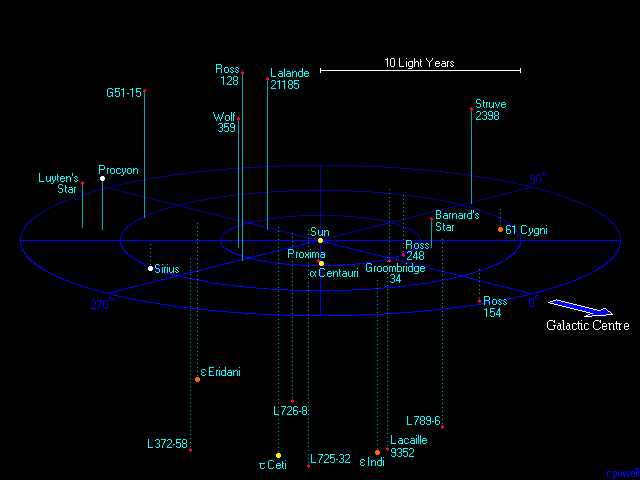
(via atlas of the universe)
Labels: #exoplanets
07 May 2014
A Dissent on Odette
(via phl dot upr dot edu)
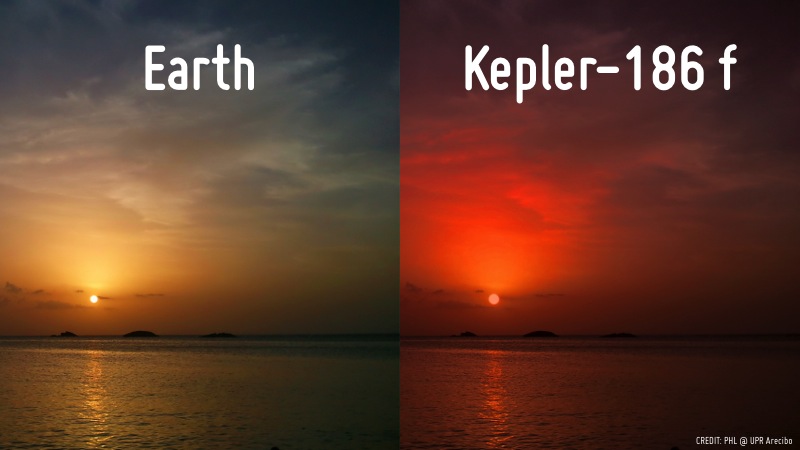
The planet Kepler-186f (in Cygnus, which is why i call it "Odette") is being touted as the latest, most likely Earth-analogue yet discovered. While i like for these exoplanets to capture public attention, albeit ill-informedly (there's already talk of "going there"--as if 3 quadrillion miles were a Sunday drive), i have only just made a few preliminary calculations, without having seen the actual scientific paper.
At 492 light years, it's not in the immediate neighborhood. That makes a parallax of something like ".00662; which with an apparent magnitude 14.625 gives a visual luminosity of 0.028038933 solar. This looks to me like a main sequence star of about K8 spectral type. (We'll come back to that question.) When i plug in K8's 3800 K stellar temperature & the corresponding bolometric correction of -0.91, i get a total luminosity of 0.064827829 solar. However, the radius produced by these numbers is 0.59315683, much different from the 0.472 given by my sources. (They say the temperature is 3788, actually.) For the mass given as 0.478, my models suggest a visual luminosity of only 0.008 solar (with that apparent magnitude, the distance would better be at 263 light years.); that should be type M0.5 with a temperature of 3375 K, BC of -1.235, & derived radius 0.87387727 (total luminosity 0.087555618). I would put the mass at 0.52-0.53 instead.
Let's assume the distance is correct. the visual luminosity suggests type K9 (3600 K) BC -1.01 which gives total luminosity 0.071167878 & stellar radius 0.692457296, which i will provisionally use. We know the planet's rotation period is 129.94598 days. When i calculate the planet's semi-major axis from mass 0.52, i get a= 0.403748549 (they say "0.36-0.41"--good agreement). This works out to a blackbody temperature of 227 K.
Finding out the planet's real temperature from there is a matter of further supposition. If it has the same albedo & greenhouse effect as Earth (A 0.36, G 38 C) the average surface temperature is -32 C. That's between Earth & Mars, as we might expect. Assuming a thicker atmosphere (A 0.4375 G 50, A 0.51 G 60) makes it -26 or -23 C. In other words, we can make it a little warmer, but not a lot.
We know a little more; two things cause a reevaluation, to my mind, of our whole picture of this planet. First, the metallicity (log Fe/H) is given as -0.28, or 52% solar. I have long used a rule of thumb, not based on actual physical processes, but which makes it possible to assign a rocky-planet assumed density per the stellar metals. (A star of lower metallicity might produce less dense planets, all other things being equal.) If i adopt, by my rule, a planetary density of 0.616595001 times Earth's, with the observed radius 1.11 the mass will be only 0.84 & the gravity 0.68. So in effect it's a smaller world... Trying a more realistic A 0.2775, G 30 gives the average temperature of -33 C. This is distinctly "Barsoom-like".
It's being assumed too blithely that the rotation of this planet would be synchronous. But its tidal effect, 3.25, comes between Venus & Mercury, neither of which is captured (--Venus if anything is synched to Earth!); some of my calculations provide a likely rotation period of 1/10th its revolution period e.g. 13 days. So a "day" is a week & a "night" is a week. I estimate, with the lesser atmosphere (the actual amount of water being an extreme unknown factor), the diurnal temperature variation being on the order of 43 C either way, from 10 C to -76 C. In sum, a fairly slow rotator, heavy ice caps north & south, considerable day-to-night temperature extremes, with a big (1.7 solar apparent size) red sun in the sky... Odette.

(via kickass.to)
------------------------------------------------------------------------------------------
(Another formula i found gives, irrespective of stellar (& perhaps planetary) metallicity, the radius of a rocky planet is proportional to its mass by the power of 0.26 or 0.27; the derived mass for Odette becomes 1.482620868; then i get a density of 1.0840796 times Earth's, & gravity 1.203328357. Which means the albedo & greenhouse effect, & thus temperature, might be more like the exact earth analogue mentioned previously. Though the diurnal temperature variation would then be less, than the final number i came up with.)
Labels: #exoplanets, #Kepler-186f
